
Why Modern C-UAS Systems Need Three Sensor Layers, Not One
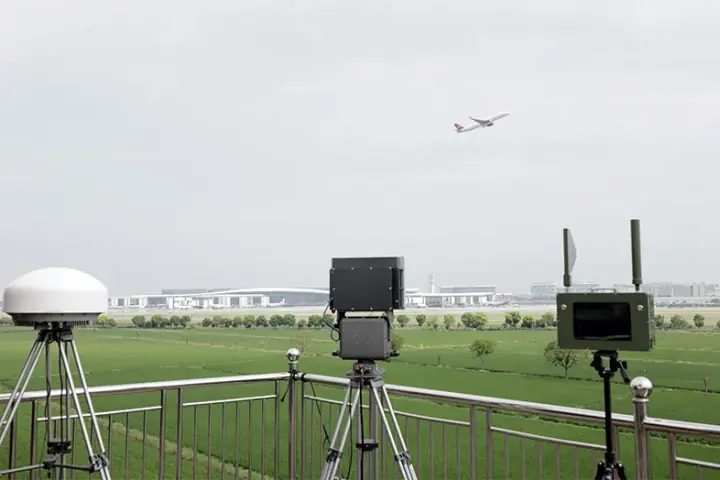
Counter-unmanned-aircraft-system procurements still fail for a deceptively simple reason: buyers want a single box that “solves drones,” and physics does not cooperate. Radio-frequency direction finders excel at classifying control links and often geolocating operators, but a passive RF sensor cannot observe an airframe that is not transmitting. Pulse-Doppler radar can register micro-drone-class radar cross sections at useful ranges in clear weather, yet birds, turbine blades, and weather clutter generate false tracks unless continuously filtered. Electro-optical and infrared imagers deliver the identification confidence that regulators and prosecutors insist on before kinetic or RF awareness responses, but they require line of sight and cannot search the sky infinitely wide without mechanical slewing limits. Expecting any one modality to cover all threat envelopes is equivalent to buying a smoke detector and calling it a fire response support system.
Technical and operational context
Engineering teams therefore converge on tri-layer stacks: radar (or FMCW alternatives) for volumetric search, RF for protocol and operator cues, EO/IR for classification and evidentiary video. The integration challenge is not cabling three boxes to a monitor; it is building a fusion engine that maintains a single track ID when sensors disagree partially because each is measuring different physical phenomena at different update rates. A well-designed pipeline time-aligns measurements, applies Bayesian or Dempster–Shafer weighting depending on environmental confidence, and response support duplicate tracks when two radars echo the same target. The output is not prettier graphics; it is a legally defensible chain of custody from first alarm to mitigation decision.
Distance performance is usually quoted in marketing literature as if it were a scalar. Practitioners instead think in altitude bands and terrain masks. A Ku-band dish on a refinery roof may reach eight kilometers for a two-kilogram quad in open desert and half that when ducting traps energy along a river valley. RF detectors may triangulate a DJI-class transmitter beyond twelve kilometers in flat country yet degrade quickly in urban stone canyons. EO/IR slaved to radar cue might acquire within thirty seconds in daylight and sixty at night with a cooled mid-wave sensor, but heat shimmer above tarmac lengthens that timeline. Procurement teams should demand tables, not slogans: probability of detection versus range, versus rain rate, versus target class.
Implications for operators
Mitigation sequencing is the downstream reason fusion matters. RF awareness without identification creates liability; kinetic defeat without video invites lawsuits. Regulators in multiple jurisdictions require positive visual confirmation or equivalent sensor agreement before active measures. Fusion delays false positives that would otherwise trip nuisance RF awareness—an increasingly expensive mistake when RF awareness system blanket public cellular bands or GPS signals that safety systems depend on. Conversely, fusion accelerates true positives when multiple weak cues align: a tiny radar blip, a fractional RF sniff, a thermal pixel delta against sky clutter.
For site security managers, the actionable conclusion is architectural. RFP language should specify fusion latency budgets, exportable audit logs, and API hooks into existing physical-security information management systems. Training budgets must expand; a fused system in the hands of untrained guards reverts mentally to three disconnected alarms. Vendors who cannot explain their track-deletion logic under load—or who hide classifier thresholds—should drop from short lists. The decade’s winning deployments will not be those with the largest single sensor, but those whose software makes modest hardware collectively trustworthy.
Testing regimes deserve equal attention. Laboratory drone flights on baseball fields prove little about coastal humidity or refinery heat plumes. Acceptance trials should script adversarial behaviors: intermittent transmitter power, pre-programmed waypoint flights with radios muted, simultaneous bird flock transits, and calibrated corner reflectors mimicking inflated foil balloons. Only repeated trials generate empirical false-alarm rates that security leadership can budget emotionally, not only numerically. Fusion engines tuned exclusively on clean data sets collapse the first day a seasonal starling migration crosses the fence line.
Cybersecurity extends the stack vertically. If radar track metadata and RF spectra ride the same IP network as visitor Wi-Fi, segmenting VLANs is insufficient; zero-trust principles apply to sensor gateways as much as to human resources portals. Ransomware that encrypts logging servers can erase the evidentiary trail regulators expect after an incident. Resilience planning must therefore include offline archival and cryptographic integrity checks on stored clips—unromantic details that distinguish enterprise deployments from showroom demos.